 By
By If you’ve been living with anxiety for any length of time, you’ve probably received a lot of advice. Breathe more. Worry less. Try yoga. Cut out caffeine. Think positive. Just relax.
And while some of that advice isn’t wrong exactly, none of it gets to the heart of what anxiety treatment actually involves — which is a structured, evidence-based process of changing the biological and psychological patterns that are keeping the anxiety going. Not managing it better. Not white-knuckling through it. Actually changing it.
The good news is that anxiety disorders are among the most treatable mental health conditions we know of. The evidence base is strong, the options are real, and the majority of people who receive appropriate treatment experience meaningful and lasting improvement. The frustrating part is that most people don’t receive appropriate treatment — either because they don’t seek help at all, or because what they receive isn’t matched well to what they actually need.
This article is a clear-eyed look at what the evidence says about anxiety treatment in the United States — what works, what doesn’t, what the options are, and how to think about putting them together.
This article is part of our anxiety series. For the full foundation on anxiety disorders, visit our Anxiety Disorders Explained guide.
The Two Main Pillars: Therapy and Medication
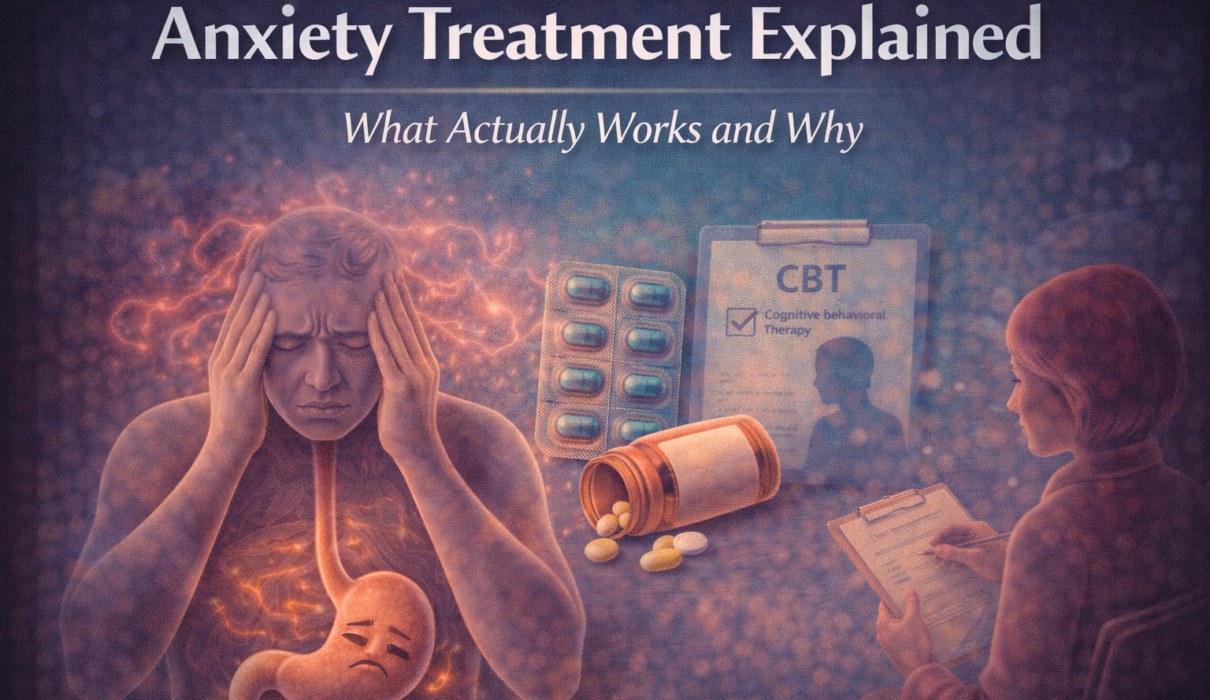
Before getting into specifics, it helps to understand the landscape. Anxiety treatment in the US generally involves two main approaches — psychotherapy and medication — and for moderate to severe anxiety disorders, the combination of both consistently produces better outcomes than either alone.
That said, not everyone needs both. Mild to moderate anxiety often responds very well to therapy alone. Some people prefer to start with therapy before considering medication. Others need medication to reduce the physiological intensity of anxiety enough to engage effectively in therapy. There’s no single right answer — the right approach depends on the severity of your anxiety, the specific disorder you have, your personal preferences, and practical considerations including cost and access.
What isn’t effective, though, is doing nothing. Anxiety disorders don’t tend to resolve on their own. Without treatment, they tend to be chronic and to gradually expand the territory they occupy in a person’s life.
Cognitive Behavioral Therapy: The Gold Standard
If there is one treatment that stands above everything else in the evidence base for anxiety disorders, it’s cognitive behavioral therapy — CBT.
CBT has been studied in thousands of randomized controlled trials across every anxiety disorder, and the results are consistent: it works, the effects are meaningful, and they last. Not just while you’re in treatment, but after it ends — because CBT teaches skills that become part of how you think and behave, rather than just suppressing symptoms while the treatment is active.
“CBT doesn’t just reduce anxiety while you’re in treatment. It changes the patterns that were generating the anxiety in the first place — which is why its effects last after therapy ends.”
So what does CBT actually do? At its core, it targets two things: the thought patterns that maintain anxiety and the behavioral patterns that keep it going.
On the cognitive side, CBT works on the tendency to overestimate threat — to interpret ambiguous situations as dangerous, to catastrophize outcomes, to assume the worst. It doesn’t tell you to think positive or pretend things aren’t difficult. It teaches you to evaluate your thoughts more accurately, to notice when your threat assessment is running ahead of the actual evidence, and to develop more realistic and balanced ways of interpreting situations.
On the behavioral side, CBT targets avoidance — the single most powerful maintaining factor in virtually every anxiety disorder. When we avoid the things that make us anxious, we get temporary relief. But that relief comes at a cost: we never learn that the feared situation is actually manageable, so the anxiety stays intact and often grows. CBT uses exposure — the gradual, systematic approach to feared situations — to teach the nervous system through direct experience that what it fears is survivable, manageable, and often not nearly as bad as anticipated.
The specifics of CBT vary by disorder. For panic disorder, it includes psychoeducation about what a panic attack actually is and interoceptive exposure — deliberately inducing physical sensations of anxiety in a controlled setting to break the association between those sensations and catastrophe. For social anxiety, it includes behavioral experiments in social situations and attention training to shift focus outward rather than inward. For GAD, it includes worry postponement, intolerance of uncertainty work, and behavioral experiments that test what actually happens when you stop trying to control everything.
| Anxiety disorder | Core CBT components |
|---|---|
| Generalized anxiety disorder | Worry postponement, uncertainty tolerance, relaxation training |
| Panic disorder | Psychoeducation, interoceptive exposure, situational exposure |
| Social anxiety disorder | Cognitive restructuring, behavioral experiments, attention retraining |
| Specific phobias | Graded exposure, relaxation techniques |
| Agoraphobia | Graduated situational exposure, safety behavior reduction |
In the United States, CBT is delivered by licensed psychologists, licensed clinical social workers, and licensed professional counselors in individual or group formats, in person or via telehealth. A typical course of CBT for an anxiety disorder involves 12 to 20 weekly sessions, though some people see significant improvement more quickly and others benefit from longer treatment.
Acceptance and Commitment Therapy: A Different Approach
CBT is the most researched anxiety treatment, but it’s not the only evidence-based option. Acceptance and commitment therapy — ACT — has a growing evidence base for anxiety disorders and offers a genuinely different approach that works better for some people than the more traditional CBT framework.
Where CBT focuses on changing the content of anxious thoughts, ACT focuses on changing your relationship to them. The idea is that struggling against anxious thoughts — trying to suppress them, argue with them, neutralize them — often makes them worse. ACT teaches psychological flexibility: the ability to notice anxious thoughts without being fused with them or compelled to act on them, and to pursue a meaningful life in the direction of your values regardless of whether anxiety is present.
It doesn’t try to eliminate anxiety. It tries to make anxiety less of an obstacle to living the life you want. For people who find cognitive restructuring difficult or who have had partial success with CBT, ACT is a genuinely valuable alternative or complement.
Medication: What’s Available and What It Actually Does
Medication for anxiety works differently from therapy. Rather than teaching skills or changing patterns, it reduces the biological intensity of the anxiety response — lowering the physiological arousal, reducing the frequency and severity of anxious episodes, and in some cases making it easier to engage in therapy. For moderate to severe anxiety disorders, medication often creates the conditions in which therapy becomes most effective.
SSRIs and SNRIs: The First Line
Selective serotonin reuptake inhibitors — SSRIs — are the first-line medication for most anxiety disorders in the United States. They’ve been studied extensively, they’re effective across a range of anxiety presentations, and they’re not habit-forming. Common options include sertraline (Zoloft), escitalopram (Lexapro), fluoxetine (Prozac), and paroxetine (Paxil).
Serotonin-norepinephrine reuptake inhibitors — SNRIs — work through a similar but broader mechanism and are also first-line options for several anxiety disorders. Venlafaxine (Effexor) and duloxetine (Cymbalta) are the most commonly prescribed.
Both SSRIs and SNRIs take four to six weeks to reach their full therapeutic effect. This is one of the most important things to know about these medications — they don’t work immediately, and many people stop taking them in the first few weeks because they don’t notice an effect yet, or because they experience mild initial side effects that they assume indicate the medication isn’t working for them.
“SSRIs take four to six weeks to work. This is one of the most important things to know — because most people who stop taking them too early do so during exactly the window when the medication is still building to its therapeutic effect.”
Common side effects in the early weeks include nausea, mild agitation, and sleep changes. These typically resolve within the first two to three weeks. Sexual side effects are more persistent for some people and worth discussing with a prescribing physician if they become significant.
Buspirone: The Underused Option
Buspirone is a non-habit-forming anxiolytic specifically indicated for generalized anxiety disorder that is significantly underused in American clinical practice. It works differently from SSRIs and benzodiazepines, acting on serotonin and dopamine receptors, and has a good tolerability profile. Like SSRIs, it requires several weeks to become effective — it’s not an as-needed medication — but it’s a valuable option for people who can’t tolerate SSRI side effects or who prefer a non-antidepressant approach for anxiety management.
Beta-Blockers: For Specific Situations
Propranolol and other beta-blockers are sometimes used situationally — before a presentation, a performance, or a high-stakes social situation — to reduce the physical symptoms of anxiety: racing heart, trembling, flushing. They don’t treat the anxiety itself and aren’t appropriate for ongoing management, but for people with performance anxiety or social anxiety facing specific high-stakes situations while broader treatment is underway, they can be genuinely useful.
Benzodiazepines: Helpful Short-Term, Complicated Long-Term
Benzodiazepines — including lorazepam (Ativan), alprazolam (Xanax), and clonazepam (Klonopin) — provide rapid, powerful relief from acute anxiety. They work within thirty to sixty minutes and are highly effective in the short term.
The complications arise with regular use. Benzodiazepines carry significant risks of physical dependence, tolerance — meaning the same dose produces less effect over time — and withdrawal symptoms that can include rebound anxiety significantly worse than the original. They also interfere with the learning process that makes exposure-based therapy effective, because they prevent the nervous system from experiencing and habituating to anxiety.
American psychiatric guidelines generally recommend benzodiazepines for short-term use only — as a bridge during the initial weeks before an SSRI takes effect, or for specific acute situations — rather than as an ongoing management strategy for anxiety disorders. If you’ve been on benzodiazepines long-term, stopping should always be done gradually and under medical supervision.
| Medication class | Best for | How long to work | Habit-forming? |
|---|---|---|---|
| SSRIs | Most anxiety disorders, long-term management | 4 to 6 weeks | No |
| SNRIs | Most anxiety disorders, long-term management | 4 to 6 weeks | No |
| Buspirone | GAD specifically, long-term management | 2 to 4 weeks | No |
| Beta-blockers | Situational performance anxiety | Minutes | No |
| Benzodiazepines | Acute short-term relief only | 30 to 60 minutes | Yes — significant risk |
Lifestyle: Not a Replacement, But Not Nothing Either
Lifestyle factors get lumped in with “wellness advice” so often that their genuine clinical relevance gets dismissed. But the evidence for certain lifestyle factors in anxiety is real and meaningful — not as replacements for therapy and medication, but as genuine contributors to the overall treatment picture.
Exercise has among the strongest non-pharmacological evidence for anxiety reduction. Consistent aerobic exercise — ideally thirty minutes of moderate intensity most days — produces measurable reductions in anxiety symptoms through multiple mechanisms: reduced cortisol reactivity, increased GABA activity, and the promotion of neuroplasticity. It’s not a substitute for CBT, but it’s a meaningful adjunct that also happens to benefit every other aspect of physical and mental health simultaneously.
Sleep and anxiety have a bidirectional relationship that makes sleep quality a legitimate treatment target. Poor sleep makes anxiety worse. Treating anxiety typically improves sleep. But when both are present, addressing sleep directly — through CBT for insomnia where appropriate — accelerates the overall recovery rather than waiting for one to improve and hoping the other follows.
Caffeine is worth addressing directly because it’s so widely consumed in the US and its effects on anxiety are genuinely significant. Caffeine directly increases physiological arousal and can worsen both the subjective experience of anxiety and the physical symptoms. For people with panic disorder especially, caffeine can lower the threshold for panic attacks. Reducing intake — particularly in the afternoon and evening — is one of the simplest and most underutilized interventions available.
Mindfulness-based stress reduction — MBSR — has a growing evidence base for anxiety, particularly through its effects on the ability to observe anxious thoughts without automatically being swept along by them. It’s not a substitute for structured therapy but complements CBT and ACT particularly well.
Combination Treatment: Why Both Usually Wins
For moderate to severe anxiety disorders, the evidence consistently points toward combining therapy and medication as the most effective approach. The two work through different mechanisms and their effects are additive.
Medication reduces the biological intensity of the anxiety — the physiological arousal, the frequency of anxious episodes — and in doing so creates conditions in which therapy is more accessible and more productive. Therapy changes the patterns that are generating the anxiety and teaches skills that persist after the medication is eventually reduced or stopped.
“Medication creates the conditions in which therapy can do its best work. Therapy produces the changes that outlast the medication. Together they cover what neither fully achieves alone.”
The typical approach in American clinical practice for moderate to severe anxiety is to start both simultaneously or to begin medication first and add therapy once the medication has started to take effect. The exact combination — which medication, which therapy approach, what intensity — is individualized based on the specific disorder, severity, patient preference, and what’s practically accessible.
Finding Treatment in the United States
Access to mental health care in the US is genuinely difficult for many people. Wait times for therapists are long. Cost is a significant barrier. Insurance coverage for mental health services, while improved since the Mental Health Parity Act, remains inconsistent. These are real obstacles, not excuses.
Some practical navigation points:
Starting with your primary care physician is often the most accessible first step. They can screen for anxiety disorders, rule out medical causes, initiate SSRI treatment, and provide referrals to mental health specialists. For many people with anxiety, primary care is where both diagnosis and initial pharmacological treatment happen.
Telehealth has genuinely expanded access to both therapy and psychiatric medication management, particularly in areas with limited local mental health providers. Platforms including BetterHelp and Talkspace provide therapy access, though quality varies and these platforms are not appropriate for everyone. For psychiatric medication management via telehealth, services including Cerebral and Done are options, though scrutiny of telehealth prescribing practices has increased in recent years and appropriate caution is warranted.
Community mental health centers offer sliding-scale fees based on income and are available in most areas of the country. The SAMHSA National Helpline at 1-800-662-4357 can connect you with local mental health resources regardless of insurance status.
The Psychology Today therapist directory at psychologytoday.com allows you to search for CBT therapists by location, insurance, and specialty. The Anxiety and Depression Association of America at adaa.org maintains a similar directory with a specific focus on anxiety specialists.
Frequently Asked Questions
Q: How long does it take for anxiety treatment to work?
CBT for anxiety typically produces meaningful improvement within six to eight weeks, with more substantial gains accumulating over a twelve to twenty week course. Medication generally takes four to six weeks to reach its full therapeutic effect. Most people with anxiety disorders experience meaningful improvement within a few months of starting appropriate treatment, though more severe or long-standing presentations may require longer treatment.
Q: Is therapy or medication better for anxiety?
Both are effective. For mild to moderate anxiety, CBT alone is often sufficient and produces durable results. For moderate to severe anxiety, the combination typically produces the best outcomes. Medication without therapy tends to work as long as the medication is taken but doesn’t produce the lasting skill-based changes that therapy does. The right choice depends on severity, personal preference, access to care, and individual response.
Q: I’ve tried an SSRI before and it didn’t work. Does that mean medication won’t work for me?
Not at all. Response to SSRIs is variable and individual. If one SSRI doesn’t work or produces intolerable side effects, a different SSRI or an SNRI may work much better. The process of finding the right medication and dose sometimes involves trying more than one option, which is frustrating but normal. A prescribing psychiatrist rather than a primary care physician is often better equipped to navigate this process for people who haven’t responded to initial medication trials.
Q: Can I get better without medication?
Yes, many people do. CBT alone is highly effective for a significant proportion of people with anxiety disorders, particularly mild to moderate presentations. Lifestyle changes including exercise, sleep optimization, and caffeine reduction contribute meaningfully. The decision about whether to include medication is individual and should be made in conversation with a healthcare provider based on the severity of your symptoms and their impact on your life.
Q: What if I can’t afford therapy?
This is a real and legitimate barrier. Community mental health centers offer sliding-scale fees based on income. Some therapists offer reduced rates for clients with financial constraints — it’s worth asking directly. University training clinics offer lower-cost therapy delivered by supervised graduate students. Digital CBT programs including those based on the Beating the Blues program offer structured CBT at lower cost than in-person therapy. The SAMHSA helpline at 1-800-662-4357 can connect you with local low-cost resources.
Disclaimer: This article is for educational purposes only and does not constitute medical advice. Always consult a qualified healthcare professional for personal mental health concerns. If you’re in crisis, call or text 988 to reach the Suicide and Crisis Lifeline.
References
American Psychiatric Association. Diagnostic and Statistical Manual of Mental Disorders, Fifth Edition, Text Revision (DSM-5-TR). Washington, DC: APA; 2022. https://www.psychiatry.org/psychiatrists/practice/dsm
Hofmann SG, Asnaani A, Vonk IJ, Sawyer AT, Fang A. The efficacy of cognitive behavioral therapy: a review of meta-analyses. Cognit Ther Res. 2012;36(5):427–440. https://pubmed.ncbi.nlm.nih.gov/23459093
Bandelow B, Michaelis S, Wedekind D. Treatment of anxiety disorders. Dialogues Clin Neurosci. 2017;19(2):93–107. https://pubmed.ncbi.nlm.nih.gov/28867934
Craske MG, Treanor M, Conway CC, Zbozinek T, Vervliet B. Maximizing exposure therapy: an inhibitory learning approach. Behav Res Ther. 2014;58:10–23. https://pubmed.ncbi.nlm.nih.gov/24864005
Stubbs B, Vancampfort D, Rosenbaum S, et al. An examination of the anxiolytic effects of exercise for people with anxiety and stress-related disorders. Psychiatry Res. 2017;249:102–108. https://pubmed.ncbi.nlm.nih.gov/28088704
National Institute of Mental Health (NIMH). Anxiety Disorders. 2023. https://www.nimh.nih.gov/health/topics/anxiety-disorders
Anxiety and Depression Association of America (ADAA). Treatment. 2023. https://adaa.org/finding-help/treatment
Substance Abuse and Mental Health Services Administration (SAMHSA). National Helpline. 2023. https://www.samhsa.gov/find-help/national-helpline