 By
By Think about the last time you optimized something about your health. Maybe you started tracking your calories. Switched to a new workout program. Cut out alcohol for a month. Added a handful of supplements to your morning routine.
Now think about how you were sleeping while you did all of that.
For most people, sleep is the thing that gets sacrificed to make room for everything else. You wake up earlier to exercise. You stay up later to meal prep or unwind. You treat sleep as the flexible variable in the equation – the thing you cut when life gets busy, and “catch up on” over the weekend.
That’s exactly backwards. And the science on this is remarkably consistent: sleep isn’t a recovery tool you use after everything else is taken care of. It’s the foundation everything else is built on. Get it wrong, and most of the other things you’re doing for your health will underperform.
What sleep actually does while you’re unconscious
Sleep feels passive because you’re not aware of it while it’s happening. But your body is doing an enormous amount of active work during those hours – work that simply cannot happen as effectively any other way.
Here’s what’s going on during a proper night of sleep:
Hormonal regulation. Growth hormone – which drives muscle repair, fat metabolism, and cellular regeneration – is released primarily during deep sleep. Cortisol, your main stress hormone, follows a daily rhythm that’s anchored to your sleep-wake cycle. Disrupt your sleep consistently and cortisol dysregulation follows. So does disruption of insulin sensitivity, which is why poor sleep and metabolic disease are so tightly linked.
Appetite signaling. Two hormones that control hunger – ghrelin (the hunger hormone) and leptin (the fullness hormone) – are both directly affected by sleep duration. When you’re sleep-deprived, ghrelin goes up and leptin goes down. Your brain receives signals telling it you’re hungry and not satisfied. This isn’t a failure of willpower. It’s your biology responding to inadequate sleep in predictable ways.
Brain maintenance. The glymphatic system – a waste-clearance network in the brain – is most active during sleep, particularly deep slow-wave sleep. It flushes out metabolic byproducts that accumulate during waking hours, including proteins linked to neurodegenerative disease. This is one reason researchers believe chronic sleep deprivation may be a risk factor for conditions like Alzheimer’s – though that research is still developing.
Memory and learning consolidation. The brain doesn’t just store the day’s experiences during sleep – it actively processes, organizes, and integrates them. This is why you can go to sleep struggling with a concept and wake up with it clicking. It’s also why pulling an all-nighter before an exam is counterproductive: you’re sacrificing the consolidation phase right before you need the information most.
Immune function. Sleep is when your immune system does much of its repair and regulation work. Consistently short sleepers – defined in research as people regularly getting less than six hours – have measurably weaker immune responses. One well-known study found that people who slept fewer than six hours per night were four times more likely to catch a cold when exposed to the virus than those who slept seven or more hours.
The metabolic connection – why sleep and weight are linked
This deserves its own section because it’s both well-established and widely underappreciated.
Poor sleep doesn’t just make you tired. It actively pushes your biology toward weight gain and metabolic dysfunction through several overlapping mechanisms.
The hormone disruption described above – more ghrelin, less leptin – increases appetite, particularly for high-calorie, high-carbohydrate foods. Sleep-deprived people don’t just eat more. They crave different things. Research using brain imaging has shown that sleep deprivation amplifies activity in the reward centers of the brain when viewing high-calorie foods – making those foods genuinely harder to resist, not just tempting.
At the same time, reduced sleep decreases insulin sensitivity. Your cells become less responsive to insulin’s signal to take up glucose from the blood. This is the same mechanism at the root of prediabetes and type 2 diabetes, and it starts showing up after just a few nights of insufficient sleep in healthy people.
“Poor sleep doesn’t just make you tired – it changes what you want to eat, how much of it feels satisfying, and how well your body handles what you consume. That’s not a motivational problem. It’s a hormonal one.”
Add to this the fact that tired people move less throughout the day – not just skipping formal exercise, but reducing all the incidental movement that contributes to daily energy expenditure – and the picture is clear. Chronic sleep restriction is a meaningful driver of weight gain and metabolic dysfunction, independent of diet and exercise.
Sleep and physical performance
If you train at all – running, lifting, playing sport, anything – your sleep is probably your biggest recovery variable, and you’re likely not treating it that way.
The adaptations you’re trying to create through training – stronger muscles, better cardiovascular efficiency, improved coordination – happen during recovery, not during the training session itself. Sleep is the primary recovery period. Shortchange it and you’re shortchanging the results of your training.
Research in athletes has consistently shown that sleep extension – deliberately spending more time in bed to increase total sleep – improves sprint performance, reaction time, accuracy, and mood. Conversely, sleep restriction impairs aerobic output, reduces time to exhaustion, slows reaction time, and increases injury risk.
The practical implication: if you’re training hard but sleeping six hours, you’d likely get better results training moderately and sleeping eight.
Sleep and mental health
The relationship between sleep and mental health runs in both directions. Poor mental health disrupts sleep; poor sleep worsens mental health. This bidirectional relationship is well-documented across anxiety, depression, and stress-related conditions.
What’s less well appreciated is how quickly sleep deprivation affects emotional regulation even in otherwise healthy people. After just one or two nights of inadequate sleep, the amygdala – the brain’s threat-detection center – becomes significantly more reactive. Things feel more threatening, more frustrating, harder to manage. The prefrontal cortex, which provides rational oversight of emotional responses, has less influence. This is why you’re shorter-tempered and more emotionally volatile when you’re sleep-deprived. It’s neurological, not character.
Over the long term, chronic insufficient sleep is associated with higher rates of anxiety disorders, depression, and burnout. Sleep doesn’t just affect how you feel day-to-day – it’s a significant determinant of long-term mental resilience.
How much sleep do you actually need?
The most common question, and the most commonly misunderstood answer.
The CDC and the American Academy of Sleep Medicine both recommend 7-9 hours of sleep per night for adults. For teenagers, the recommendation is 8-10 hours. For school-age children, even more.
| Age group | Recommended sleep per night (CDC/AASM) |
|---|---|
| School-age children (6-12 years) | 9-12 hours |
| Teenagers (13-18 years) | 8-10 hours |
| Adults (18-60 years) | 7 or more hours |
| Older adults (61+ years) | 7-9 hours |
A few important points about these numbers:
The “I function fine on five hours” claim is almost never true. Research on subjective sleep perception consistently shows that chronically sleep-deprived people lose the ability to accurately assess how impaired they are. You feel like you’re functioning fine. Objective measures of cognitive performance show otherwise.
Individual variation exists but is much smaller than people claim. Genuine short sleepers – people who are genetically able to function well on six hours or less – exist but are rare, estimated at less than 3% of the population. Most people claiming this identity are simply adapted to feeling tired.
Quality matters alongside quantity. Eight hours of fragmented, shallow sleep doesn’t deliver the same benefit as eight hours of consolidated, deep sleep. Sleep continuity and architecture – the cycling through different sleep stages – matter.
Timing matters. Sleep between 10pm and 6am isn’t biologically identical to sleep between 3am and 11am. The body’s circadian rhythm influences which hormones are released at what times, and misalignment between your sleep timing and your circadian phase (which is roughly anchored to light-dark cycles) reduces sleep quality even when total hours are adequate.
Why “catching up on weekends” doesn’t work
The idea of sleep debt – that you can rack up a deficit during the week and pay it back on the weekend – is appealing but mostly wrong.
Some aspects of acute sleep deprivation do recover with extra sleep. Mood, subjective sleepiness, and basic reaction time improve. But the metabolic impairments, the immune effects, and the cognitive deficits from chronic sleep restriction don’t fully reverse with weekend recovery sleep. Research has shown that even after three days of recovery sleep following a week of restriction, metabolic markers don’t fully return to baseline.
More practically: irregular sleep schedules create a form of social jet lag – where your sleep timing shifts significantly between weekdays and weekends. This misalignment with your circadian rhythm carries its own health costs, independent of total sleep hours.
Consistency matters more than heroic weekend sleep sessions.
What actually gets in the way of good sleep
Most adults know they should sleep more. The obstacles are usually practical, not informational.
Light exposure, especially at night. Light signals the brain to suppress melatonin, the hormone that initiates sleep. Blue-spectrum light from screens is particularly potent at this. Exposure to bright light in the hour or two before bed delays sleep onset meaningfully for many people.
Caffeine timing. Caffeine’s half-life in the body is around five to six hours, meaning half of the caffeine in a 3pm coffee is still in your system at 9pm. For people who are slow caffeine metabolizers, the effects last even longer. Afternoon caffeine regularly delays sleep onset and reduces deep sleep time even when you don’t feel like it’s affecting you.
Inconsistent schedule. Your circadian system works best with regular anchor points – consistent wake times especially. Variable schedules make it harder for your body to build up the sleep pressure needed to fall asleep easily at night.
Alcohol. Alcohol helps people fall asleep but disrupts sleep architecture, particularly suppressing REM sleep. People who drink before bed often wake in the second half of the night as the sedating effect wears off and the arousal effect kicks in.
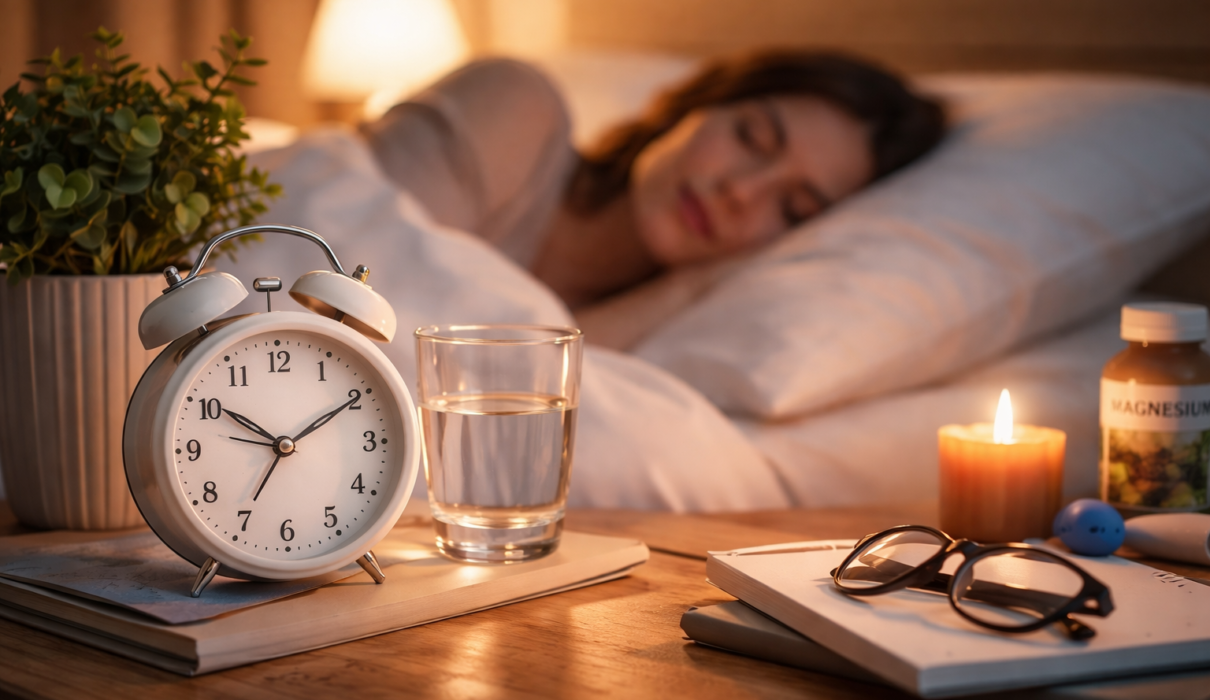
Temperature. Core body temperature needs to drop slightly to initiate sleep. A bedroom that’s too warm interferes with this. Most sleep research suggests a room temperature of around 65-68°F (18-20°C) is close to optimal for most adults.
Mental overstimulation close to bedtime. Work emails, stressful conversations, emotionally charged content, and unresolved problems all activate arousal systems that are incompatible with sleep onset. The brain needs wind-down time – not a hard cutoff, but a gradual deceleration.
“Most sleep problems aren’t mysterious. They’re the predictable result of specific behaviors – late-night screens, inconsistent schedules, afternoon caffeine, and bright artificial light – that directly interfere with the biology of sleep initiation and maintenance.”
A practical approach – what actually helps
The sleep hygiene recommendations that actually have consistent evidence behind them are simpler than most people expect:
- Keep a consistent wake time seven days a week – this is the single most important anchor for your sleep-wake rhythm
- Get bright light exposure in the morning, ideally within an hour of waking
- Stop caffeine by early afternoon (noon to 2pm is a reasonable target for most people)
- Keep the bedroom cool, dark, and quiet
- Reduce screen exposure in the last hour before bed, or use blue-light filtering modes
- Don’t go to bed until you’re actually sleepy – lying in bed awake trains your brain to associate bed with wakefulness
These aren’t perfect rules – they’re levers. Pulling more of them in the right direction consistently produces better sleep for most people. You don’t need to implement all of them overnight. Pick the one or two with the most room for improvement in your current routine and start there.
FAQs
Is it really true that sleep affects weight loss? Yes – and the mechanism is well-established. Sleep deprivation raises ghrelin (hunger hormone), lowers leptin (fullness hormone), reduces insulin sensitivity, increases cravings for high-calorie foods, and decreases spontaneous physical activity. People trying to lose weight while chronically sleep-deprived are working against their own biology. Improving sleep is a legitimate weight management strategy, not a soft suggestion.
Can I make up for lost sleep on weekends? Partially, but not fully. Acute subjective symptoms like tiredness and mood improve with recovery sleep. But the metabolic, immune, and cognitive effects of chronic sleep restriction don’t fully reverse over a weekend. More importantly, inconsistent schedules create circadian disruption that carries its own health costs. Consistency during the week matters more than compensation on weekends.
What’s the best sleep position for health? The evidence doesn’t strongly favor one position over another for general health in people without specific conditions. Side sleeping is often recommended for people who snore or have sleep apnea, and left-side sleeping is sometimes suggested for people with acid reflux. For most people, whatever position allows consistent, comfortable sleep is the best position.
Do sleep apps and trackers actually help? Consumer sleep trackers are reasonable for identifying broad patterns – whether you’re getting roughly adequate sleep, whether your schedule is consistent, whether you seem to be waking frequently. They’re not accurate for measuring specific sleep stages. Some people find them motivating; others develop anxiety about their sleep data, which can ironically worsen sleep. If tracking helps you prioritize sleep without adding stress, it’s useful. If it’s making you anxious, it’s not worth it.
Should I take melatonin to sleep better? Melatonin is most useful for circadian timing issues – jet lag, shift work, or deliberately shifting your sleep schedule. For general sleep quality in people with a normal schedule, the evidence is weaker than most people assume. Commercial supplements typically contain 3-10mg, far above the 0.3mg the body naturally produces – lower doses are generally considered more appropriate when melatonin is used at all. Address behavioral factors first, and talk to a doctor if sleep difficulties persist before defaulting to supplements.
Disclaimer
This article is for educational purposes only and does not constitute medical advice. If you have persistent sleep difficulties, symptoms of a sleep disorder such as sleep apnea, insomnia disorder, or restless leg syndrome, or if poor sleep is significantly affecting your daily functioning, please consult a qualified healthcare provider. This content is not a substitute for professional medical evaluation or treatment.
References
- Watson NF, et al. (2015). Recommended amount of sleep for a healthy adult: A joint consensus statement of the American Academy of Sleep Medicine and Sleep Research Society. Sleep, 38(6), 843-844. https://doi.org/10.5665/sleep.4716
- Spiegel K, Tasali E, Penev P, Van Cauter E. (2004). Brief communication: Sleep curtailment in healthy young men is associated with decreased leptin levels, elevated ghrelin levels, and increased hunger and appetite. Annals of Internal Medicine, 141(11), 846-850. https://doi.org/10.7326/0003-4819-141-11-200412070-00008
- Prather AA, Janicki-Deverts D, Hall MH, Cohen S. (2015). Behaviorally assessed sleep and susceptibility to the common cold. Sleep, 38(9), 1353-1359. https://doi.org/10.5665/sleep.4968
- Centers for Disease Control and Prevention. (2024). Sleep and sleep disorders. https://www.cdc.gov/sleep/index.html
- Xie L, et al. (2013). Sleep drives metabolite clearance from the adult brain. Science, 342(6156), 373-377. https://doi.org/10.1126/science.1241224
- Leproult R, Van Cauter E. (2010). Role of sleep and sleep loss in hormonal release and metabolism. Endocrine Development, 17, 11-21. https://doi.org/10.1159/000262524
- Mah CD, et al. (2011). The effects of sleep extension on the athletic performance of collegiate basketball players. Sleep, 34(7), 943-950. https://doi.org/10.5665/SLEEP.1132
- National Heart, Lung, and Blood Institute. (2024). Sleep deprivation and deficiency. https://www.nhlbi.nih.gov/health/sleep-deprivation