

 By
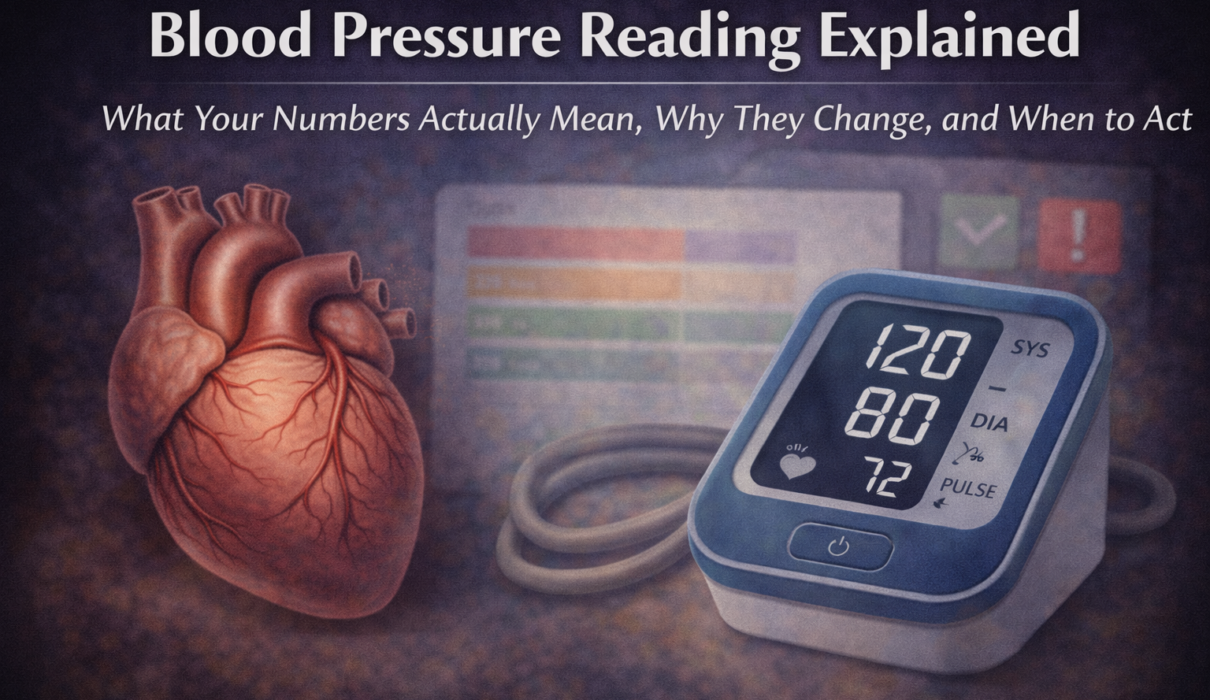
By Your blood pressure was checked. The nurse called out two numbers. You nodded, got dressed, and left — probably with only a vague sense of whether that was good or bad.
This happens thousands of times a day, in clinics across every country. Blood pressure is one of the most frequently measured values in all of medicine. It is also one of the least understood by the people it’s being measured in.
That’s not a knock on patients. It’s a failure of explanation.
This article fixes that. By the end, you’ll understand exactly what those two numbers mean, how blood pressure is properly measured, what each stage of classification actually implies, what causes readings to fluctuate, and — critically — when a number needs action and when it doesn’t.
What blood pressure actually measures
Every time your heart beats, it contracts and forces blood out into your arteries. That blood has to travel through a closed system of vessels — from large arteries near the heart, down to tiny capillaries in your fingers and toes, and back again through your veins.
Blood pressure is the force that blood exerts against the inner walls of your arteries as it moves through this system.
Think of a garden hose. If you put your thumb partly over the end, the pressure builds — the water pushes harder against the walls of the hose. Your arteries work on the same principle. If they become narrower (from plaque buildup, inflammation, or spasm), or if the volume of blood increases, or if the heart pumps harder than usual — pressure rises.
Sustained high pressure damages artery walls. It accelerates atherosclerosis. It forces the heart to work harder over time, eventually enlarging and weakening it. It stresses the kidneys and the small blood vessels in the eyes and brain. All of this happens silently, over years, before any symptoms appear.
That is why blood pressure is measured — not because a single reading tells your doctor everything, but because tracking it over time reveals one of the most important indicators of cardiovascular health.
Understanding the two numbers
Blood pressure is always expressed as two numbers, written one over the other — for example, 124/78 mmHg.
Systolic pressure — the top number
This is the pressure in your arteries at the moment your heart contracts and pushes blood forward. It is the peak pressure in the system with each heartbeat. For most adults, anything below 120 mmHg is considered normal.
Diastolic pressure — the bottom number
This is the pressure in your arteries when your heart is relaxed between beats — the lowest point in each cardiac cycle. For most adults, below 80 mmHg is normal.
mmHg — what does that unit mean?
mmHg stands for millimetres of mercury. It’s a pressure unit inherited from the original sphygmomanometers — mercury-filled glass columns that measured pressure by how high the mercury rose. Modern devices are electronic, but the unit has remained the global standard.
Which number matters more?
Both matter — but in different ways, and in different patient groups.
In younger adults, diastolic pressure tends to be the more clinically significant number. In older adults (over 50–60), systolic pressure becomes the stronger predictor of cardiovascular risk — because ageing arteries lose elasticity, causing systolic pressure to rise even as diastolic pressure may stay normal or even fall.
Isolated systolic hypertension (high systolic, normal diastolic) is the most common form of hypertension in people over 65, and it carries real cardiovascular risk even when the bottom number looks fine.
The short answer: don’t focus on one and ignore the other. Your doctor considers both.
The blood pressure classification table
The following classifications are based on the American Heart Association / American College of Cardiology (AHA/ACC) 2017 guidelines, which are the most widely referenced internationally and broadly consistent with Indian (ICMR/CSI) guidelines.
| Category | Systolic | Diastolic | What it means | |
|---|---|---|---|---|
| Normal | Less than 120 | and | Less than 80 | Healthy range. Maintain lifestyle. |
| Elevated | 120–129 | and | Less than 80 | Not yet hypertension, but trending up. Lifestyle changes needed. |
| High — Stage 1 | 130–139 | or | 80–89 | Hypertension confirmed. Lifestyle changes required; medication may be recommended depending on overall risk. |
| High — Stage 2 | 140 or higher | or | 90 or higher | Significant hypertension. Lifestyle changes plus medication are usually indicated. |
| Hypertensive Crisis | Higher than 180 | or | Higher than 120 | Medical emergency. Seek care immediately. |
One important nuance: a single elevated reading does not diagnose hypertension. The diagnosis requires consistently elevated readings — typically on two or more separate occasions. This is why your doctor may ask you to come back for a repeat measurement, or recommend home monitoring, before making a diagnosis.
How blood pressure is properly measured
The way a blood pressure reading is taken matters enormously — and most people have had it taken incorrectly at some point. Here’s what the correct technique looks like.
Before the measurement
You should have been sitting quietly for at least 5 minutes before the cuff goes on. No coffee, tea, or cigarettes in the 30 minutes prior. No talking during the measurement. Bladder should be empty. You should not have exercised in the past 30 minutes.
These aren’t arbitrary rules. Each of them can affect a reading by 5–10 mmHg — enough to push someone from normal into the elevated category, or from Stage 1 into Stage 2.
During the measurement
The cuff should be placed on bare skin, not over clothing. It should fit properly — a cuff that’s too small will give a falsely high reading. Your arm should be supported at heart level, not hanging at your side (which adds hydrostatic pressure and raises the reading). Your back should be supported; your feet should be flat on the floor, not crossed.
Which arm?
Ideally, blood pressure should be checked in both arms at least once. A difference of more than 10–15 mmHg between arms consistently can indicate vascular disease and should be investigated. Ongoing monitoring is then done in the arm with the higher reading.
Multiple readings
A single reading is unreliable. Best practice is to take two or three readings, about 1–2 minutes apart, and average them. Clinics often skip this due to time pressure. If yours did, it doesn’t necessarily mean the reading was wrong — but it does mean a single high result should be interpreted cautiously.
Why blood pressure changes throughout the day
Blood pressure is not a fixed number. It rises and falls constantly in response to what your body is doing and experiencing. Understanding this is essential to interpreting readings correctly.
Normal daily variation — Blood pressure follows a circadian rhythm. It’s typically lowest during sleep (10–20% lower than daytime levels), rises sharply in the morning within an hour or two of waking (the “morning surge”), and varies throughout the day based on activity and stress.
Physical activity — Exercise raises systolic pressure significantly during the activity, then usually lowers it afterwards. Regular exercise lowers resting blood pressure over time.
Emotional state — Anxiety, stress, pain, and excitement all raise blood pressure acutely. This is not pathological — it’s a normal autonomic response. The problem is when emotional or stress-driven elevation becomes chronic.
Temperature — Cold constricts blood vessels and raises pressure. This is why hypertensive events and strokes are more common in winter.
Caffeine — Raises blood pressure transiently, particularly in people who don’t consume it regularly.
Full bladder — Can add 10–15 mmHg to a reading.
Talking — Even speaking during measurement can raise systolic BP by 10 mmHg.
White coat hypertension — and why it matters
White coat hypertension refers to blood pressure that is consistently elevated in a clinical setting but normal at home or during ambulatory monitoring.
It occurs in roughly 15–30% of people who appear hypertensive on clinic measurement. The mechanism is an anxiety-driven sympathetic response to the clinical environment — the white coat, the unfamiliar setting, the anticipation of a “bad result.”
For years, white coat hypertension was considered benign — just nerves. More recent evidence suggests it’s not entirely harmless and may reflect an exaggerated stress response that carries some cardiovascular risk. But it is still meaningfully different from true sustained hypertension, and treating it with medication based solely on clinic readings would be inappropriate for many patients.
The flip side is masked hypertension — normal readings in clinic, elevated readings during daily life. This is arguably more dangerous because it goes undetected. It’s more common in people who are stressed at work, consume a lot of alcohol, or have sleep apnoea.
Both patterns are why home monitoring and ambulatory blood pressure monitoring (ABPM — a cuff worn for 24 hours) exist and are clinically valuable.
How to measure blood pressure correctly at home
Home monitoring is recommended by most major hypertension guidelines. It provides more data points, captures the true daily pattern, and eliminates white coat effects.
Use a validated upper-arm device — not a wrist monitor, which is less accurate. Sit quietly for 5 minutes before measuring. Take measurements at the same time each day — ideally morning and evening. Take two readings per session, 1–2 minutes apart, and record both. Do this for 7 days before a scheduled doctor’s appointment and bring the record with you.
A home average of 135/85 mmHg or above is considered hypertensive — note that home thresholds are slightly lower than clinic thresholds because home readings tend to run 5 mmHg lower on average.
Pulse pressure — the number nobody tells you about
Pulse pressure is the difference between your systolic and diastolic readings. If your BP is 130/80, your pulse pressure is 50 mmHg.
Normal pulse pressure is typically 40–60 mmHg.
A widened pulse pressure (above 60 mmHg) in older adults often indicates arterial stiffness — the arteries have lost elasticity and can no longer cushion the pressure wave from each heartbeat effectively. This is an independent risk factor for cardiovascular disease.
A narrowed pulse pressure (below 25 mmHg) can indicate reduced heart function, significant blood loss, or cardiac tamponade — and is a sign that warrants urgent evaluation.
Your doctor may not always comment on pulse pressure, but it’s useful context when you’re reviewing your own readings.
What additional tests might follow an abnormal reading
A high blood pressure reading on its own doesn’t tell your doctor what’s causing it or how much damage, if any, has already occurred. Depending on the reading and your overall profile, they may order:
Blood tests — kidney function (urea, creatinine, eGFR), electrolytes (sodium, potassium), fasting glucose, HbA1c, lipid profile, thyroid function (if secondary hypertension is suspected).
Urine test — urinalysis and spot urine albumin:creatinine ratio, to look for early kidney involvement.
ECG — to check for left ventricular hypertrophy (the heart enlarging in response to chronically high pressure) or arrhythmias.
Echocardiogram — a more detailed look at heart structure and function, if ECG suggests changes.
Ambulatory BP monitoring (ABPM) — 24-hour BP recording, considered the gold standard for diagnosis in most guidelines.
Eye examination — hypertensive retinopathy (damage to the small blood vessels of the retina) can be detected on fundoscopy and is a marker of end-organ damage.
Common mistakes that lead to wrong readings
Cuff over clothing — adds 5–50 mmHg depending on thickness.
Arm not supported — hanging arm can add 10 mmHg.
Talking during measurement — adds up to 10 mmHg systolic.
Not resting beforehand — rushing from the waiting room to the chair and being measured immediately can give a falsely elevated reading.
Wrong cuff size — too small raises the reading, too large lowers it.
Crossed legs — raises diastolic pressure by around 5 mmHg.
Measuring immediately after caffeine or exercise — transiently elevated by both.
If you’ve ever been told your blood pressure “came back high” in a rushed clinical setting and found yourself wondering whether the reading was accurate — this list is why that doubt is sometimes legitimate.
When to seek medical attention
A single mildly elevated reading in an otherwise well person is not an emergency. But the following warrant prompt medical attention:
Any reading above 180/120 mmHg — this is a hypertensive crisis. If accompanied by symptoms (severe headache, chest pain, shortness of breath, visual changes, confusion), call emergency services immediately.
Consistently elevated readings at home over 7 days — see your doctor even if you feel well.
A sudden significant rise from your usual baseline — particularly if accompanied by any symptoms.
Any reading that concerns you — if you’re unsure, ask. A blood pressure check takes two minutes and answers the question definitively.
What your doctor is actually thinking when they see your numbers
Blood pressure is never interpreted in isolation. A reading of 138/88 in a 35-year-old with no other risk factors is managed very differently from the same reading in a 60-year-old with diabetes, elevated cholesterol, and a family history of stroke.
Your doctor is also considering: your trend over time (is it rising?), your other cardiovascular risk factors, any signs of end-organ damage, your response to lifestyle changes, and whether symptoms are present.
This is why the instruction “go away and reduce your salt intake, come back in 3 months” for a mildly elevated reading isn’t dismissiveness — it’s often the medically correct approach for lower-risk patients.
Key takeaways
Blood pressure measures the force of blood against artery walls, expressed as systolic (heart contracting) over diastolic (heart relaxing).
Normal is below 120/80 mmHg. Hypertension begins at 130/80 (Stage 1). Above 180/120 is a crisis.
How the measurement is taken matters enormously — incorrect technique produces unreliable numbers.
Blood pressure changes throughout the day. Single readings are informative but not definitive.
White coat hypertension (elevated in clinic, normal at home) and masked hypertension (normal in clinic, elevated at home) are both real and clinically significant.
Home monitoring with a validated upper-arm device is recommended and provides better data than occasional clinic readings.
An abnormal reading is the beginning of an investigation — not a final verdict. Context, trends, and additional tests all contribute to the full picture.
Disclaimer: This article is for educational purposes only and does not constitute medical advice.
References
American Heart Association / American College of Cardiology. 2017 Guideline for the Prevention, Detection, Evaluation, and Management of High Blood Pressure in Adults.
World Health Organization. Global brief on hypertension: Silent killer, global public health crisis. WHO, 2023.
National Institute for Health and Care Excellence (NICE). Hypertension in adults: diagnosis and management. NICE guideline NG136, updated 2023.
Indian Council of Medical Research / Cardiological Society of India. Consensus statement on hypertension management in India.
Williams B, et al. 2018 ESC/ESH Guidelines for the management of arterial hypertension. European Heart Journal, 2018.




1 Comment